

TACTICAL MILITARY EXPERIENCE MEETS ULTRA RUNNING

TACTICAL MILITARY EXPERIENCE MEETS ULTRA RUNNING

Kate Dzienis • June 27, 2018

ARTICLE ORIGINALLY PUBLISHED IN R4YL MAGAZINE JUNE/JULY 2018 ISSUE #78 BY KATE DZIENIS

AURA member Tony Smith from Perth, WA recaps his time in the military and how it has helped him with his ultra running. According to his Strava statistics, Smith’s PBs include 3:32:55 for the 50k (April, 2016), and 8:31:23 in the 100k (January, 2018).

With the high rise of the moon near-on midnight November 12, 2016 a private dawn service is held for 25 ultra runners. Complete with The Last Post played on a bugle and a minute’s silence, a commemoration is observed before entrants of the Lighthorse Ultra 12hr event head out into a darkened, night-silent course in Western Australian bushlands just 23kms north of Perth.


It’s the kind of place where Australian history survives, as a mixture of sand, cycle path, and compacted limestone takes runners past an 1870s-built residence, now in ruins, as well as foundations and remnants of other buildings scattered throughout the regional park.


And amongst those runners, a former British military soldier who had been meticulously planning his race for weeks.


Planning strategically, and meticulously, as all tactical soldiers do, for a podium finish.


It’s difficult to envisage Tony Smith making any enemies in life. Modest, yet confidently spoken, Tony has established himself in WA as a major gun to give others a run for their money, particularly when it comes to going against him in long distance events. And he’s not giving up his top dog place in the running community any time soon.


Now aged 47, Tony began running as a young boy in the south of England. After discovering the coordination that came with ball sports just didn’t reflect all that well on him, he engaged vivaciously with school cross country and track events – and found a calling that would embody a part of who he was to become later in life.


Tony’s father set the scene with his own successful military career, providing a safe and secure family environment, and teaching the discipline, hard work and respect that many military families encompass. Straight out of school at the tender age of 17, Tony tried his hand as an apprentice vehicle mechanic, but feeling it wasn’t for him soon followed in his father’s footsteps and joined the British military.


From a Private Soldier to a decorated Warrant Officer of the highest ranking, Tony gave 24 years of his life to the armed forces before packing up all his treasured belongings and moving permanently to WA with his wife. It’s those two decades of time and utmost experience as a serving military officer which has given him the mental resilience and physical prowess to attain podium places in almost all of his official races in the state he now calls home.


“The British military is very big on its enlisted soldiers playing sport – you don’t need to excel at it, but you do need to be of a reasonably good standard,” he says.


“Each unit will have a football team, or a soccer team for instance, and it’s an important part of military life because it all comes down to team work.


“Even if you are doing an individual sport like running, you’ll be part of a cross country or road racing team because it becomes less about the individual, and all about everyone else to get a good result.”


Whilst Tony took advantage of becoming a part of his unit’s running team, he honed in on a physical ability which would see develop into a secret weapon for future races. His combat training was well and truly creating an electrically fast runner, and despite getting older during his time as a soldier, Tony soon found himself becoming the army’s junior sports team manager.


And when it comes to life after serving, initial military training never really goes away – in particular all that is mental.


“When you leave the military, and as you get older, you need to recalibrate your goals, and in terms of running I had to begin moving smarter rather than just faster,” he says.


“The 50k run is where I’m reasonably strongest, because that’s where I can put into place a plan of sorts, a strategy, and it’s where I know I’ll get the most satisfaction.”


To provide an overview of Tony’s most recent achievements in the running calendar, he won the Goldfields Pipeline Marathon in both 2014 and 2016, took home gold at the 2015 Australia Day Ultra 50k (3:48:13), claimed first place in the 2016 Feral Pig Trail Ultra 50k in a time of 4:11:36 and stood tall while taking second overall at the 2016 Lighthorse Ultra 6hr (123.880k) where he personally ran in remembrance for all military personnel.

Overall, he has raced more than two dozen ultra marathons, and after just a few races throughout 2017, he’s come back with a vengeance – taking gold at the HBF Three Waters Bunbury Running Festival 50k in early April this year with a time of 3:35:28.


Tony, who is an avid parkrunner and a member of the Australian Ultra Runners Association, says it all comes down to strategic planning – just like you would when planning a military operation.


“My planning is more about what’s controllable around me,” he explains.


“The military is very big on planning, so before you do anything, before you carry out an operation, there has to be a plan in place, you can’t go in blind.


“There’s also a ‘what if’ strategy, a contingency plan, that is created, and in the end it all comes down to what I want to achieve out of my race.


“Anything I can control I’ll plan for, but I also have to be flexible with what I strategise for because things can go differently, things can go wrong, and you need to be able to work with that to still get the outcome you’re after.


“My initial plan at the Bunbury 50k was to run out and get myself a PB, which would have meant I’d have had to run at a pretty consistent pace and hold it the whole way through, but that all changed the morning of the race when a certain fast runner I knew showed up, one I hadn’t intended on seeing.


“My plan instantly changed; the only way I could actually beat him was to run a different race, so I eased myself from the start and then went quite hard in the middle to catch up to him and play with his mental game by passing him.


“To my advantage, it worked, despite my pace dropping right back towards the end considering I’d given all I had at that point. So there was no PB for me, but I was okay with that because my plan had changed to win the race, not gain a PB.”


The tactic Tony used is likened to taking advantage of an enemy’s vulnerabilities, whereby setting the right amount of threat can be detrimental to the opponent. Since leaving the military (2012) and settling in Australia, Tony hasn’t gone so far as to really enforce this sort of threat in his races, but he sure does use what he learnt over two decades of strict training to see his strategies go to plan.


‘The old cliché of ‘plan to fail, don’t fail to plan’ is very much true,” he says.


“Be flexible with your race preparations, there needs to be movement for adjustability right then and there, and you need to learn to accept those changes if the time ever comes for them.


“Anything you have no control of, like the weather or participant numbers, there’s no point in stressing over and trying to change it, because that won’t happen.


“Just let it go and change the tactic to suit your needs so you get the race you want.”


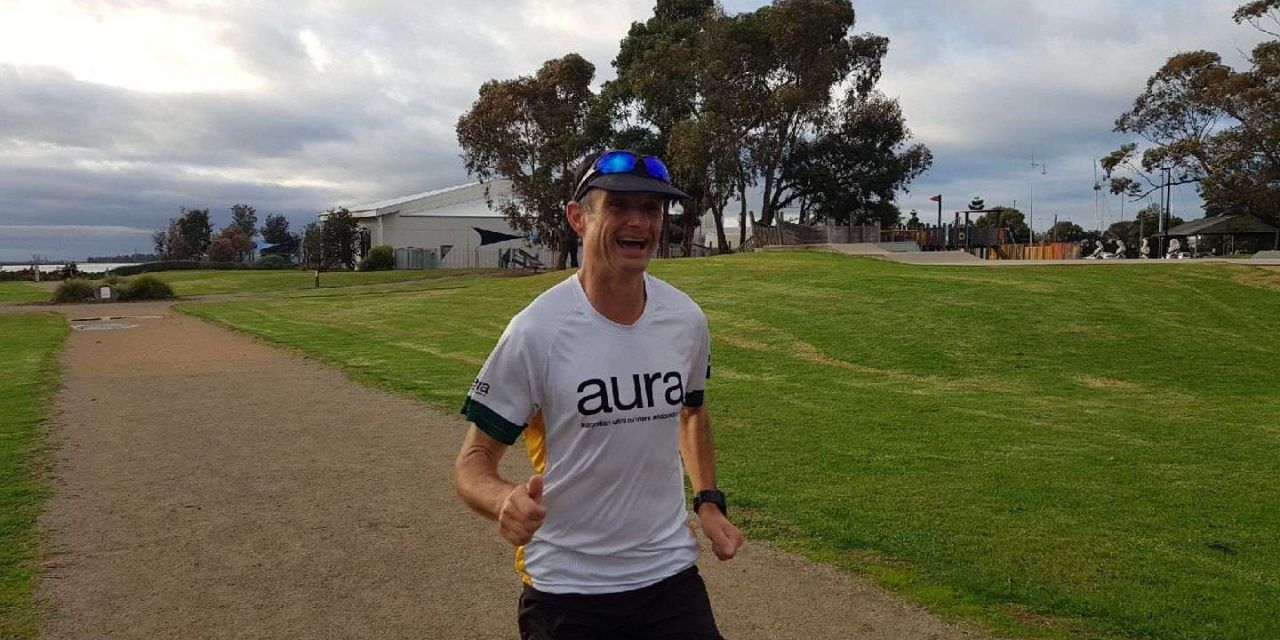
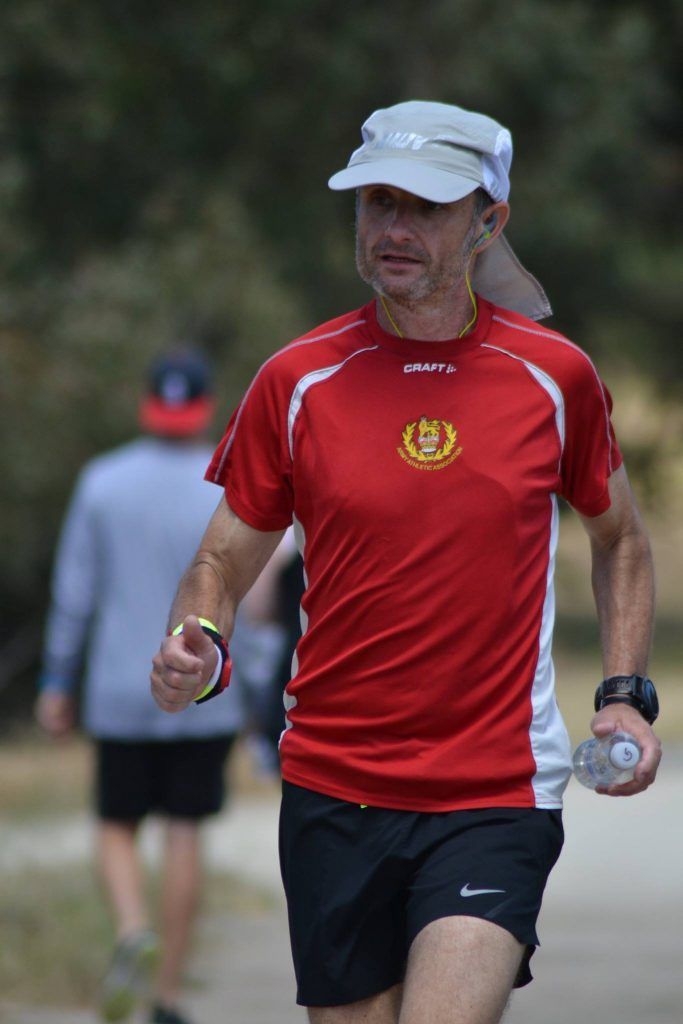
Pictured (feature image): Tony Smith at Hastings Foreshore parkrun in early May for his 250th parkrun. Photograph – Supplied/Facebook.

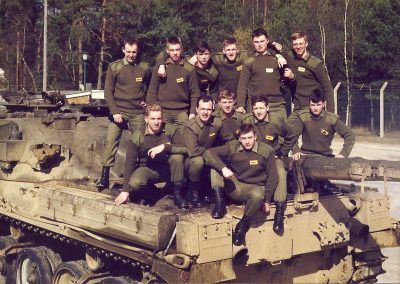
Pictured (army): Tony Smith’s first year in the army, 1988. He is pictured in the front row on the far right. Photograph – Supplied.

Pictured: Tony Smith racing in the 2016 Lighthorse Ultra 50k in WA. Photograph – Jon Storey.

July 30, 2026
Contributed by Jamie Oborne, red dirt backyard event organising team & LOS
By John Claridge July 30, 2026
JULY 2026
By Jessica Short July 22, 2026
Your voice matters. Help shape the future of our sport
By Kate Dzienis July 19, 2026
Race results for 2026 Southern Sydney Track Ultra, 3M3D, Ultra Adelaide and Boyne Valley 50.
By Jin Kato July 8, 2026
The world-class trails of Kunanyi/Mt Wellington will play centre-stage for one of the country’s fastest-growing sports, after the Kunanyi Mountain Run (KMR) was awarded the hosting rights for the first-ever combined Australian Mountain and Trail Running Championships (AMTRC). KMR was awarded the National Championships after a competitive bid process, overseen by the Australian Ultra and Trail Running Association (AUTRA) and Australian Athletics (AA). AUTRA President, John Claridge, said that KMR “offered everything we were looking for”. “World-class trails, proven event management and a passionate community. It provides the perfect stage for Australia's first combined National Trail Championships," he said. It’s expected that Australia’s elite mountain and trail running athletes, and support crew, will travel to Hobart, as they vie for a spot in the Australian team that competes at the 2027 World Mountain and Trail Running Championships. "This is a landmark moment for trail running in Australia,” Mr Claridge said. "We're excited about what this championship represents; not just next year, but for the future of trail running in Australia... helping grow the sport and inspire the next generation of trail runners." The 2027 AMTRC at KMR will be the first time that all championship distances have been held together, at the one festival. “It aligns us more closely with the way World Championships are presented, creating a stronger pathway for athletes and raising the profile of the sport,” Mr Claridge said. KMR, a 3-day trail running festival which has been held annually since 2022, expects to draw more than 1500 runners and hikers from across Tasmania, Australia and internationally next year. The AMTRC will be embedded within KMR’s existing event program, allowing elite athletes to compete for the national titles, while sharing the same spectacular trails and event-experience as recreational runners. “We’re honoured to have been selected as host,” KMR’s founder and director, Lincoln Quilliam said. “KMR continues to welcome runners, and hikers, of all abilities. From the elites who want to represent Australia on the world stage, the group of mates or work colleagues who run the team relay together, the mums returning to running after having a baby, as well as those who are trying trail running for the very first time,” Mr Quilliam said. Tasmanian runner, Jessica Collins, who has represented Australia, said it was exciting news for KMR, Tasmania and the sport. “This is such a great opportunity for Australian athletes. I’ve run many of the KMR events and know the courses and the terrain are on par with what we see at the World Champs,” she said. The City of Hobart has supported Kunanyi Mountain Run since its inception, and Lord Mayor Anna Reynolds said she was “thrilled” with the news. “Events like this not only showcase the natural beauty of our region but also reinforce Hobart’s reputation as a vibrant destination for world-class outdoor experiences.” The 2026 edition of KMR brought in $4 million to the Tasmanian economy, generating more than 8000 bed nights across the state, which Alex Heroys, Chief Executive of Destination Southern Tasmania, said was a “significant return for the visitor economy”. “Kunanyi / Mount Wellington is one of Tasmania’s great natural assets, and the Kunanyi Mountain Run shows exactly how powerful events can be in driving regional tourism,” he said. “We have an epic mountain right on Hobart’s doorstep, an airport less than 30 minutes away, and a city that is well set up to welcome thousands of visiting athletes, support crews and spectators.” “This event also reinforces Tasmania’s growing reputation as a world-class trail running destination. With steep, technical trails and real mountain terrain, Kunanyi offers conditions that are genuinely comparable to what athletes will experience at the World Championships, making it an ideal place to compete, train and visit.” For more information: Kunanyi Mountain Run Dates: 19-21 March 2027 Pic credit: David Nolan & Ryan Slater
LOAD MORE

share this

IN OTHER NEWS

July 30, 2026
Contributed by Jamie Oborne, red dirt backyard event organising team & LOS
By John Claridge July 30, 2026
JULY 2026
By Jessica Short July 22, 2026
Your voice matters. Help shape the future of our sport
ALL NEWS