

RETROSPECTIVE ARTICLE FROM ULTRAMAG SEPT 2013 “A HISTORY OF AUSTRALIAN ABORIGINAL ULTRA DISTANCE”

RETROSPECTIVE ARTICLE FROM ULTRAMAG SEPT 2013 “A HISTORY OF AUSTRALIAN ABORIGINAL ULTRA DISTANCE”

Kate Dzienis • March 30, 2020

A HISTORY OF AUSTRALIAN ABORIGINAL ULTRA DISTANCE by ANDY MILROY
First published in Ultramag in September, 2013

For most of the last three and a half million years, human beings and their predecessors have been nomads, moving at frequent intervals to new sources of food. Such a wandering life puts a premium on the ability to endure.

There emerged the cultural role of runners whose primary task was that of messenger, supporting fast communication between dispersed groups, and enabling coordinated action between sub-tribes, clans and villages. Such messengers played a crucial role in Australian Aboriginal society, often covering hundreds of kilometres. These messengers probably pre-date the more famous Hemerodromoi ( or “day runners”) of Ancient Greece, and almost certainly the Running Footmen of Europe of the 15th-19th centuries.

Aboriginal tribes were widely scattered. In Tasmania, for example, each band had had a territmy of some 500 to 750 square kilometres. In the Northern Territories they lived in an area four and a half times the size of Great Britain.

There were over 200 different Aboriginal languages, and 600 dialects throughout Australia, but no written language. Traditionally the message stick was carried by a messenger. Usually a solid piece of wood, it was around 20-30cm in length, cut or etched with angular dots and lines. Such sticks were traditionally passed between different groups to transmit messages or convey information. They were often used to invite neighbouring groups to corroborees or ceremonies, to set fights to resolve conflicts, to feasts when a particular food was especially plentiful, or ball games.

Each stick was carved in a way that would help the carrier remember the verbal message he was to convey. Message sticks enabled a complex or very long message to be sent by messenger “carried in his mouth.” The stick also proved to the person receiving the message that it was genuine. The use of message sticks was not universal in Australia and sometimes other symbols were carried. A man’s kilt carried on the point of a spear was the call for assembling a war band.

When impmiant ceremonies were about to take place messengers were always sent out, often to distant tribes. An important member or recognised leader of the group provided a messenger and sent him out with an object. Possession of this object showed all he met that he was a messenger. Usually the messenger would be a relative of the person who sent the message and, if possible, someone who had a relative in the tribe to whom the message was being sent. Sometimes such messengers were multilingual and were used as translators.

Edward Micklethwaite Curr, writing in 1886, gave more detailed information about these messengers: Alone on foot, between tribes 30 to 130 miles apart, often across country where both water and game are scarce, and without pay or reward of any sort…. The messengers I have known personally have all been among the oldish men, spare in person, under the medium height, rather silent and generally widowers…. [The carved stick] he often carries whilst travelling, stuck into the netted head band [ which he wore around his head.]

When the messenger came to a camp, he would sit down and wait until the local band chose to acknowledge him. One or more of the older men would approach him and he would show them the object and deliver his message. Then he was brought into the camp and provided with hospitality. This process was followed at every camp he visited. Such message carrymg also performed part of the initiation ceremonies for young boys, who were sent on journeys to distant and unknown tribes which could last for months. Each carried a small wand, or stick, which guaranteed his protection. This custom of granting protection to messengers seems to have varied according to the area. The protection of messengers was later extended to Aborigines who were carrying messages for white settlers.

Such a letter was always called a “paper yabber” and carried in a cleft stick so that it could be easily seen. Around 1913, an Aboriginal carried a “paper yabber” for Baldwin Spencer (the Special Commissioner for Aboriginals in the Northern Territory) over 90 miles in this fashion, and Spencer commented “They not infrequently traverse longer distances than this, the cleft stick acting as a safe passp01i.” White settlers themselves also employed message sticks when sending messages using Aboriginal messengers, using the notches to signify specific numbers as a reminder to the bearer of the message.

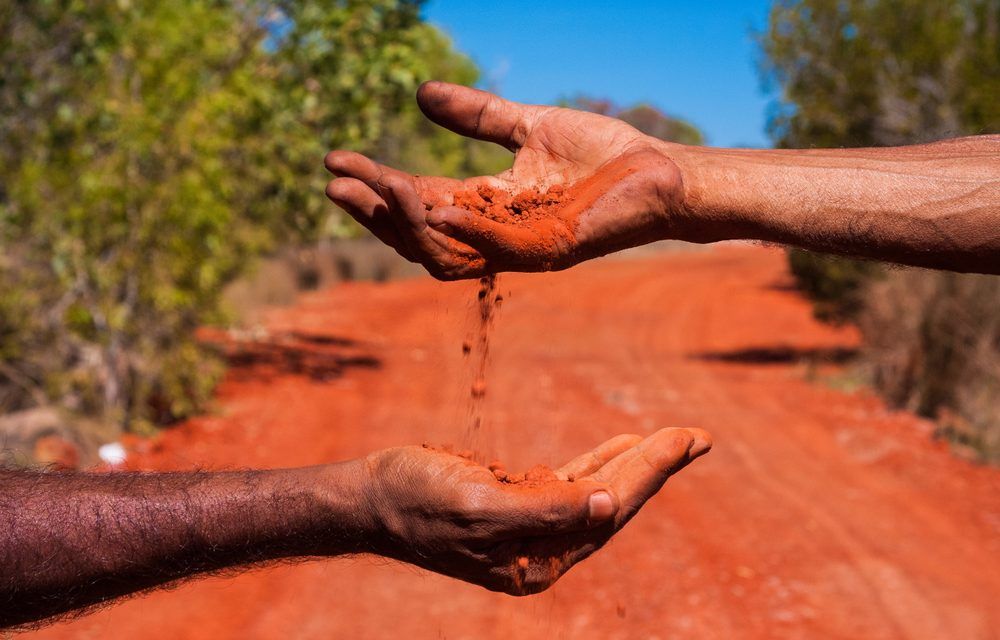
However, Aboriginal endurance capabilities were not just revealed through their use of messengers. The red ochre from South Australia has been traded for thousands of years across Australia and Aborigines travelled from Cloncuny, QLD to an ochre mine in the Flinders Ranges in SA to exchange shields for specialised ochre. Others came from Alice Springs and carried 25kg blocks of the Yarrakina ochre from Parachilna in the Flinders Ranges over a distance of 1000km. Aboriginal endurance also fit into the white settlers’ world. The use of the “paper yabber” has already been mentioned, but in New Zealand, Andy Bittern, an Aboriginal tracker and early Canterbury rural mailman in probably the 1850s and 60s, was said to have often brought mail on foot to Christchurch from 140km away, in the same day, in the hours of light. In the N 01ihem Territories during WWII, Aborigines walked 190km ULTRAMAG Page 51 ( 119 miles) to rescue an American pilot, Lieutenant J. Martin, who had been shot down in flames. In 1954, Mr. Malparinga, a Pitinjara who escaped from Alice Springs gaol, walked 193km (120 miles) in 48 hours to successfully shake off police trackers.

Despite this endurance background, documented examples of Aboriginal distance running in races appear to be few and far between. The concept of running specific distances on a track or road loop, for instance, do not chime well with covering great distances across the open outback. One of the few documented examples of longer distance running by an indigenous Australian took place in November 2005, when 70 year old Albert (Alby) Clarke, an elder from the Gunditjmara tribe in Warrnambool, competed in the Cliff Young Australian 6 Day Race at Colac, Victoria, where he covered 344.8km. In November 2007 Clarke subsequently ran the 300km from Melbourne’s Parliament House to the Framlingham Aboriginal Community to help raise awareness of the life expectancy gap between Aboriginal and Torres Strait Islanders and other Australians.

Study of what could well be the oldest endurance culture in the world gives unique understanding of both the sport of distance running and of wider human culture.

Published in Ultramag, page 50, September 2013. Access the full Ultramag here.
By Jin Kato July 8, 2026
The world-class trails of Kunanyi/Mt Wellington will play centre-stage for one of the country’s fastest-growing sports, after the Kunanyi Mountain Run (KMR) was awarded the hosting rights for the first-ever combined Australian Mountain and Trail Running Championships (AMTRC). KMR was awarded the National Championships after a competitive bid process, overseen by the Australian Ultra and Trail Running Association (AUTRA) and Australian Athletics (AA). AUTRA President, John Claridge, said that KMR “offered everything we were looking for”. “World-class trails, proven event management and a passionate community. It provides the perfect stage for Australia's first combined National Trail Championships," he said. It’s expected that Australia’s elite mountain and trail running athletes, and support crew, will travel to Hobart, as they vie for a spot in the Australian team that competes at the 2027 World Mountain and Trail Running Championships. "This is a landmark moment for trail running in Australia,” Mr Claridge said. "We're excited about what this championship represents; not just next year, but for the future of trail running in Australia... helping grow the sport and inspire the next generation of trail runners." The 2027 AMTRC at KMR will be the first time that all championship distances have been held together, at the one festival. “It aligns us more closely with the way World Championships are presented, creating a stronger pathway for athletes and raising the profile of the sport,” Mr Claridge said. KMR, a 3-day trail running festival which has been held annually since 2022, expects to draw more than 1500 runners and hikers from across Tasmania, Australia and internationally next year. The AMTRC will be embedded within KMR’s existing event program, allowing elite athletes to compete for the national titles, while sharing the same spectacular trails and event-experience as recreational runners. “We’re honoured to have been selected as host,” KMR’s founder and director, Lincoln Quilliam said. “KMR continues to welcome runners, and hikers, of all abilities. From the elites who want to represent Australia on the world stage, the group of mates or work colleagues who run the team relay together, the mums returning to running after having a baby, as well as those who are trying trail running for the very first time,” Mr Quilliam said. Tasmanian runner, Jessica Collins, who has represented Australia, said it was exciting news for KMR, Tasmania and the sport. “This is such a great opportunity for Australian athletes. I’ve run many of the KMR events and know the courses and the terrain are on par with what we see at the World Champs,” she said. The City of Hobart has supported Kunanyi Mountain Run since its inception, and Lord Mayor Anna Reynolds said she was “thrilled” with the news. “Events like this not only showcase the natural beauty of our region but also reinforce Hobart’s reputation as a vibrant destination for world-class outdoor experiences.” The 2026 edition of KMR brought in $4 million to the Tasmanian economy, generating more than 8000 bed nights across the state, which Alex Heroys, Chief Executive of Destination Southern Tasmania, said was a “significant return for the visitor economy”. “Kunanyi / Mount Wellington is one of Tasmania’s great natural assets, and the Kunanyi Mountain Run shows exactly how powerful events can be in driving regional tourism,” he said. “We have an epic mountain right on Hobart’s doorstep, an airport less than 30 minutes away, and a city that is well set up to welcome thousands of visiting athletes, support crews and spectators.” “This event also reinforces Tasmania’s growing reputation as a world-class trail running destination. With steep, technical trails and real mountain terrain, Kunanyi offers conditions that are genuinely comparable to what athletes will experience at the World Championships, making it an ideal place to compete, train and visit.” For more information: Kunanyi Mountain Run Dates: 19-21 March 2027 Pic credit: David Nolan & Ryan Slater
By Jin Kato July 7, 2026
AUTRA are excited to announce our national championship events for 2027!
June 29, 2026
Greg Wilson recaps his time at the 2026 New Zealand 6 Day Ultra
June 29, 2026
Isobel tait covers what actually changes when the sun goes down
By John Claridge June 29, 2026
APRIL 2026
LOAD MORE

share this

IN OTHER NEWS

By Jin Kato July 8, 2026
The world-class trails of Kunanyi/Mt Wellington will play centre-stage for one of the country’s fastest-growing sports, after the Kunanyi Mountain Run (KMR) was awarded the hosting rights for the first-ever combined Australian Mountain and Trail Running Championships (AMTRC). KMR was awarded the National Championships after a competitive bid process, overseen by the Australian Ultra and Trail Running Association (AUTRA) and Australian Athletics (AA). AUTRA President, John Claridge, said that KMR “offered everything we were looking for”. “World-class trails, proven event management and a passionate community. It provides the perfect stage for Australia's first combined National Trail Championships," he said. It’s expected that Australia’s elite mountain and trail running athletes, and support crew, will travel to Hobart, as they vie for a spot in the Australian team that competes at the 2027 World Mountain and Trail Running Championships. "This is a landmark moment for trail running in Australia,” Mr Claridge said. "We're excited about what this championship represents; not just next year, but for the future of trail running in Australia... helping grow the sport and inspire the next generation of trail runners." The 2027 AMTRC at KMR will be the first time that all championship distances have been held together, at the one festival. “It aligns us more closely with the way World Championships are presented, creating a stronger pathway for athletes and raising the profile of the sport,” Mr Claridge said. KMR, a 3-day trail running festival which has been held annually since 2022, expects to draw more than 1500 runners and hikers from across Tasmania, Australia and internationally next year. The AMTRC will be embedded within KMR’s existing event program, allowing elite athletes to compete for the national titles, while sharing the same spectacular trails and event-experience as recreational runners. “We’re honoured to have been selected as host,” KMR’s founder and director, Lincoln Quilliam said. “KMR continues to welcome runners, and hikers, of all abilities. From the elites who want to represent Australia on the world stage, the group of mates or work colleagues who run the team relay together, the mums returning to running after having a baby, as well as those who are trying trail running for the very first time,” Mr Quilliam said. Tasmanian runner, Jessica Collins, who has represented Australia, said it was exciting news for KMR, Tasmania and the sport. “This is such a great opportunity for Australian athletes. I’ve run many of the KMR events and know the courses and the terrain are on par with what we see at the World Champs,” she said. The City of Hobart has supported Kunanyi Mountain Run since its inception, and Lord Mayor Anna Reynolds said she was “thrilled” with the news. “Events like this not only showcase the natural beauty of our region but also reinforce Hobart’s reputation as a vibrant destination for world-class outdoor experiences.” The 2026 edition of KMR brought in $4 million to the Tasmanian economy, generating more than 8000 bed nights across the state, which Alex Heroys, Chief Executive of Destination Southern Tasmania, said was a “significant return for the visitor economy”. “Kunanyi / Mount Wellington is one of Tasmania’s great natural assets, and the Kunanyi Mountain Run shows exactly how powerful events can be in driving regional tourism,” he said. “We have an epic mountain right on Hobart’s doorstep, an airport less than 30 minutes away, and a city that is well set up to welcome thousands of visiting athletes, support crews and spectators.” “This event also reinforces Tasmania’s growing reputation as a world-class trail running destination. With steep, technical trails and real mountain terrain, Kunanyi offers conditions that are genuinely comparable to what athletes will experience at the World Championships, making it an ideal place to compete, train and visit.” For more information: Kunanyi Mountain Run Dates: 19-21 March 2027 Pic credit: David Nolan & Ryan Slater
By Jin Kato July 7, 2026
AUTRA are excited to announce our national championship events for 2027!
June 29, 2026
Greg Wilson recaps his time at the 2026 New Zealand 6 Day Ultra
ALL NEWS