



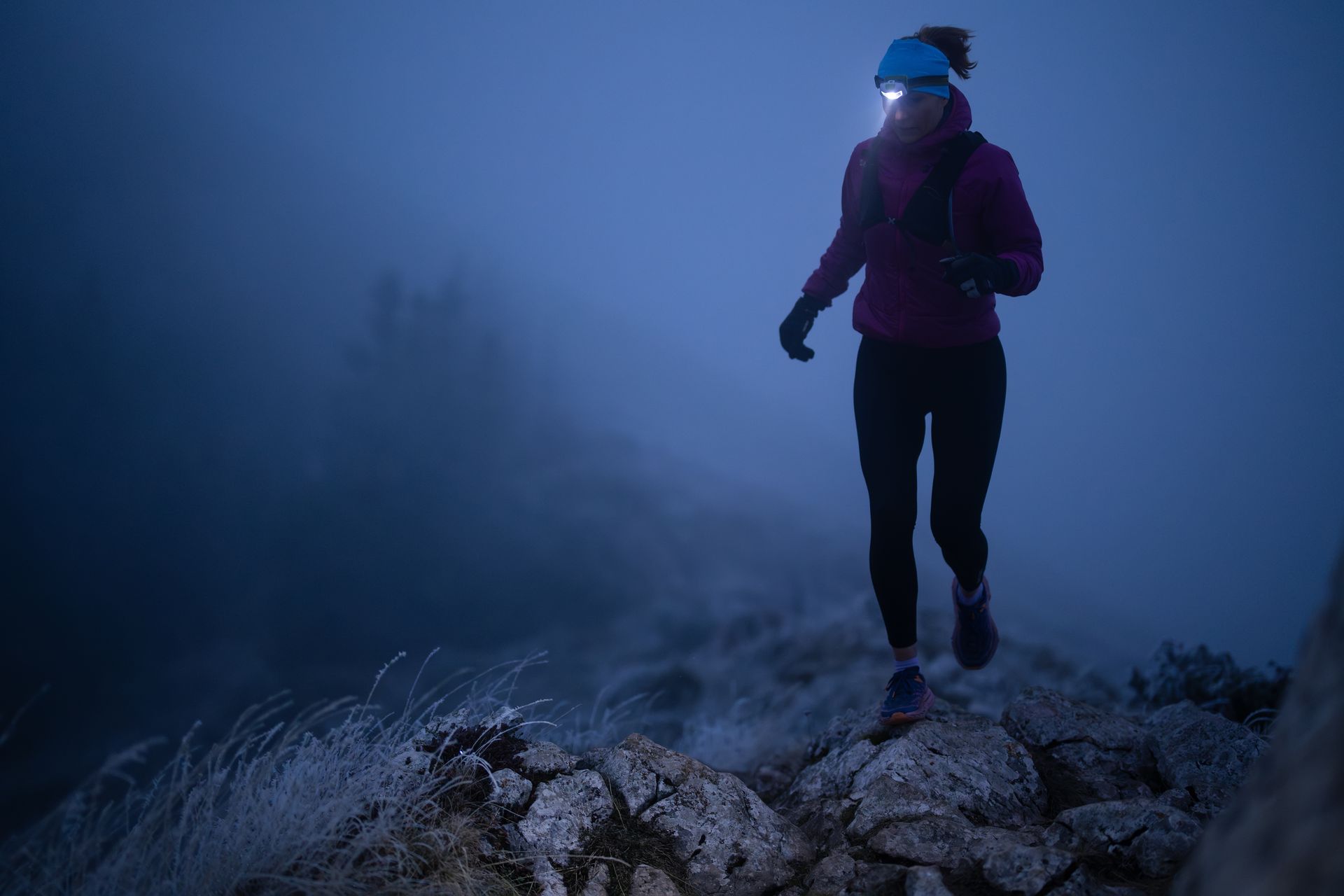
COACH’S CORNER - Running at Night by Isobel Tait
Isobel tait covers what actually changes when the sun goes down
One of my athletes asked me recently: can we do one of our monthly athlete webinar sessions on running at night? She had never done it in a race before, felt nervous about it, and wanted to know what actually changes. She was clear that sleep deprivation was not her concern. She had dealt with enough shift work to have that handled. What she wanted to know about was pacing in the dark, what gear actually matters, and the things nobody writes or really talks about.
It is a good question. And the fact that she was asking it before her race rather than after is already an advantage.
Night running gets a lot of attention for the wrong reasons. Sleep deprivation dominates the conversation, which is understandable but not always the most useful place to focus. Most experienced ultra runners who have managed shift work or early starts have a reasonable handle on running on reduced sleep. What actually catches people out is the operational side of it. Pacing when you cannot see the terrain ahead. Understanding what happens to your body and brain in the early hours of the morning. Knowing what gear makes a real difference and what is just marketing.
This is what I want to cover here.
IT’S NOT JUST RUNNING IN THE DARK
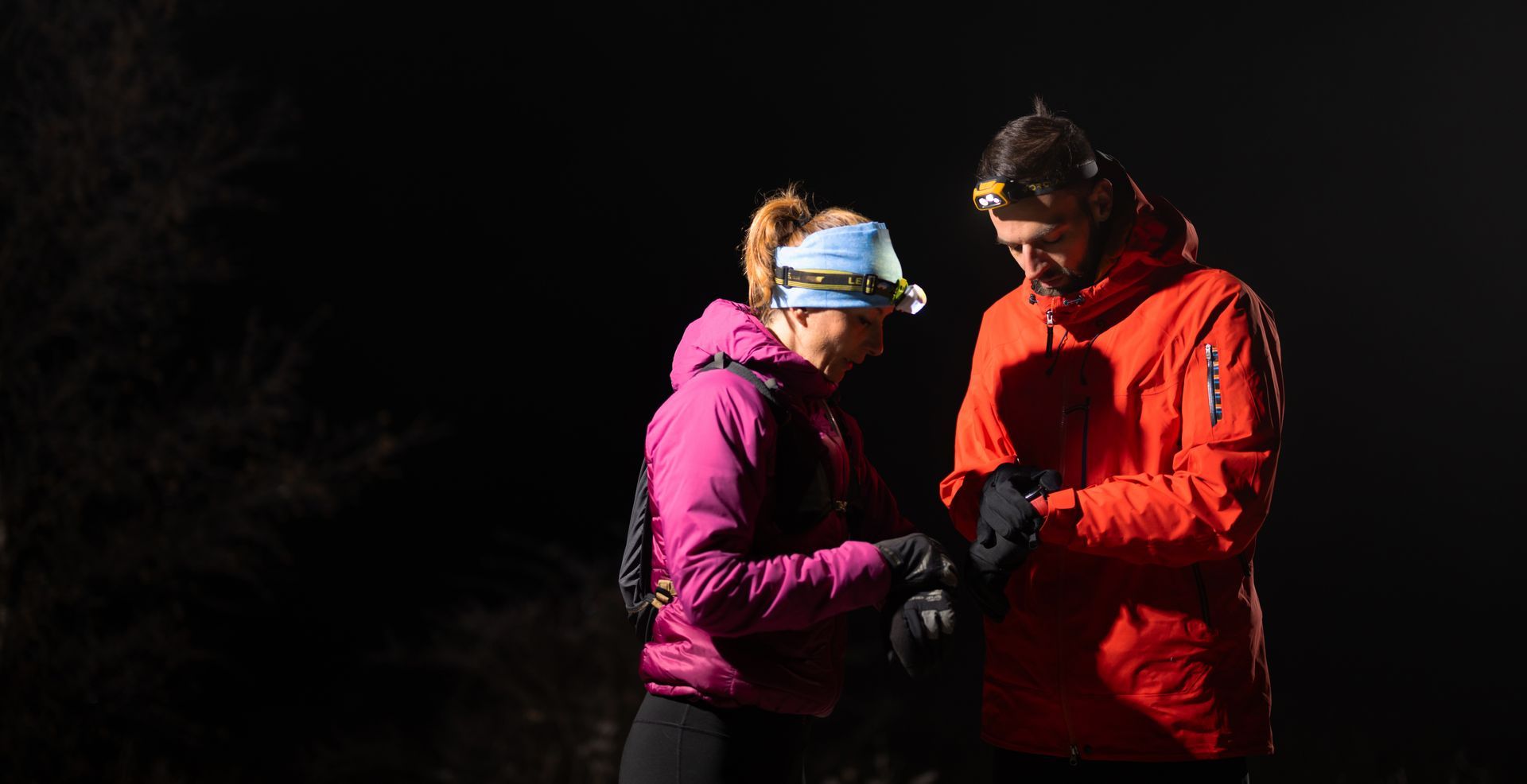
The first thing to understand is that night running genuinely changes what your body and brain do. It is not just a visibility problem with a headtorch solution.
Your visual field narrows to whatever your headtorch illuminates. In daylight you are constantly reading terrain in advance, making micro-adjustments, processing a wide field of information. At night that disappears. You stop anticipating and start reacting, which is slower and more tiring than most people expect.
Depth perception degrades too. A headtorch creates flat lighting. Shadows fall directly away from the light source, which means rocks and roots directly in front of you cast almost no shadow. Your brain loses a lot of the depth information it normally uses to judge the height and position of obstacles. This is why technical terrain feels harder and slower at night even when your fitness is unchanged.
There is also the horizon. Most runners never think about it, but you use it constantly for balance and orientation. Lose it and your body works harder to stay upright, particularly on uneven or cambered ground.
Then there is the psychological shift. Time perception changes in the dark. Kilometres feel longer. Things that would be manageable in daylight hit harder at 2am. That is not a mental weakness. That is a normal human response to running in a reduced sensory environment for an extended period of time, and at a time when they are normally asleep.
The athletes who handle night running well are not the ones who ignore that it is different. They are the ones who prepared for it specifically.
THE CIRCADIAN DIP
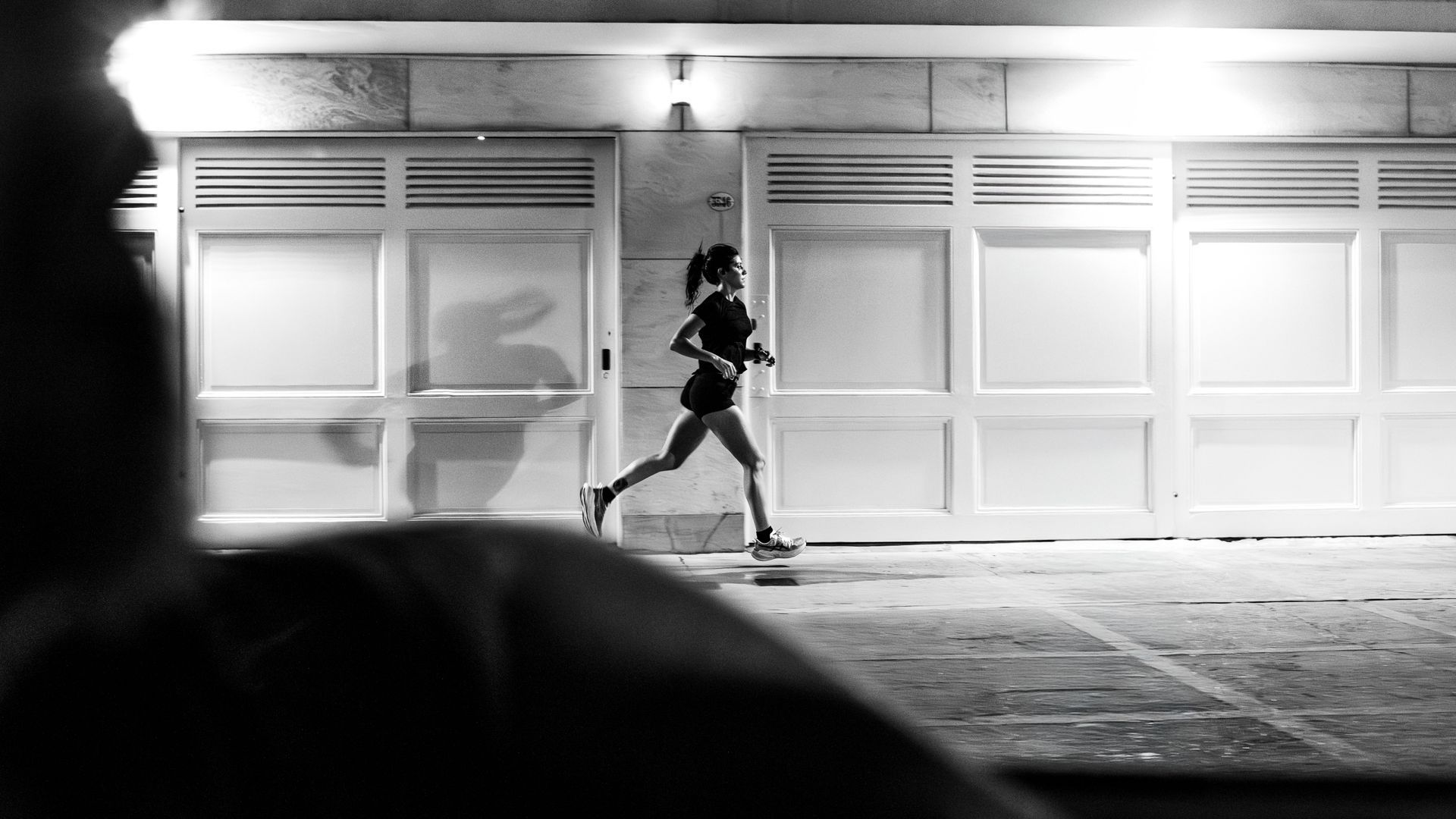
Your circadian rhythm drives a drop in core body temperature in the early hours of the morning. For most people this bottoms out somewhere between 1am and 3am. When core temperature drops, perceived effort increases. The same pace that felt controlled at 8pm will feel a lot harder at 2am.
Knowing this changes how you respond when it happens. If you hit that window and everything feels harder and your pace has dropped, the wrong response is to panic or push harder to compensate. The right response is to recognise it, hold your effort steady, eat something, and keep moving. It passes. It’s not about how fit you are. It’s about the time that it is. The athletes who blow up here are almost always the ones who did not know it was coming and interpreted the drop in performance as something going wrong with their race.
PACING AT NIGHT
The core problem is this. In daylight you pace using a combination of GPS, perceived exertion, and visual cues from the terrain ahead. At night, two of those three are compromised. You cannot read what is coming, and your GPS pace becomes misleading on technical ground where you are moving carefully through difficult sections.
The rules I give my athletes are straightforward
- Do not try to match your daytime pace. Night terrain takes longer. That is correct, not a problem. Treating it as a problem and overriding your body to compensate is how athletes blow up in night sections.
- Shift to effort-based pacing. Set a ceiling on heart rate, not a floor on speed. Let the terrain dictate how fast you move and use heart rate as your governor. A target of 10 to 15 percent slower on technical night terrain is a reasonable reality check, not a ceiling to hit. To be honest, I believe in and encourage effort-based pacing for your whole race.
- Watch the headtorch trap. Your eyes will follow the beam and you will find yourself looking further ahead than is safe on technical terrain. Keep your gaze 3 to 5 metres out and scan regularly. Tunnel vision on a night section is a fast way to end up on the ground.
- Use your breathing. In the absence of visual cues, your breathing pattern is your most reliable real-time feedback. Athletes who practise running by breath in training have a calibrated internal system that works at night. If you have never done it, a night race is a hard time to start.
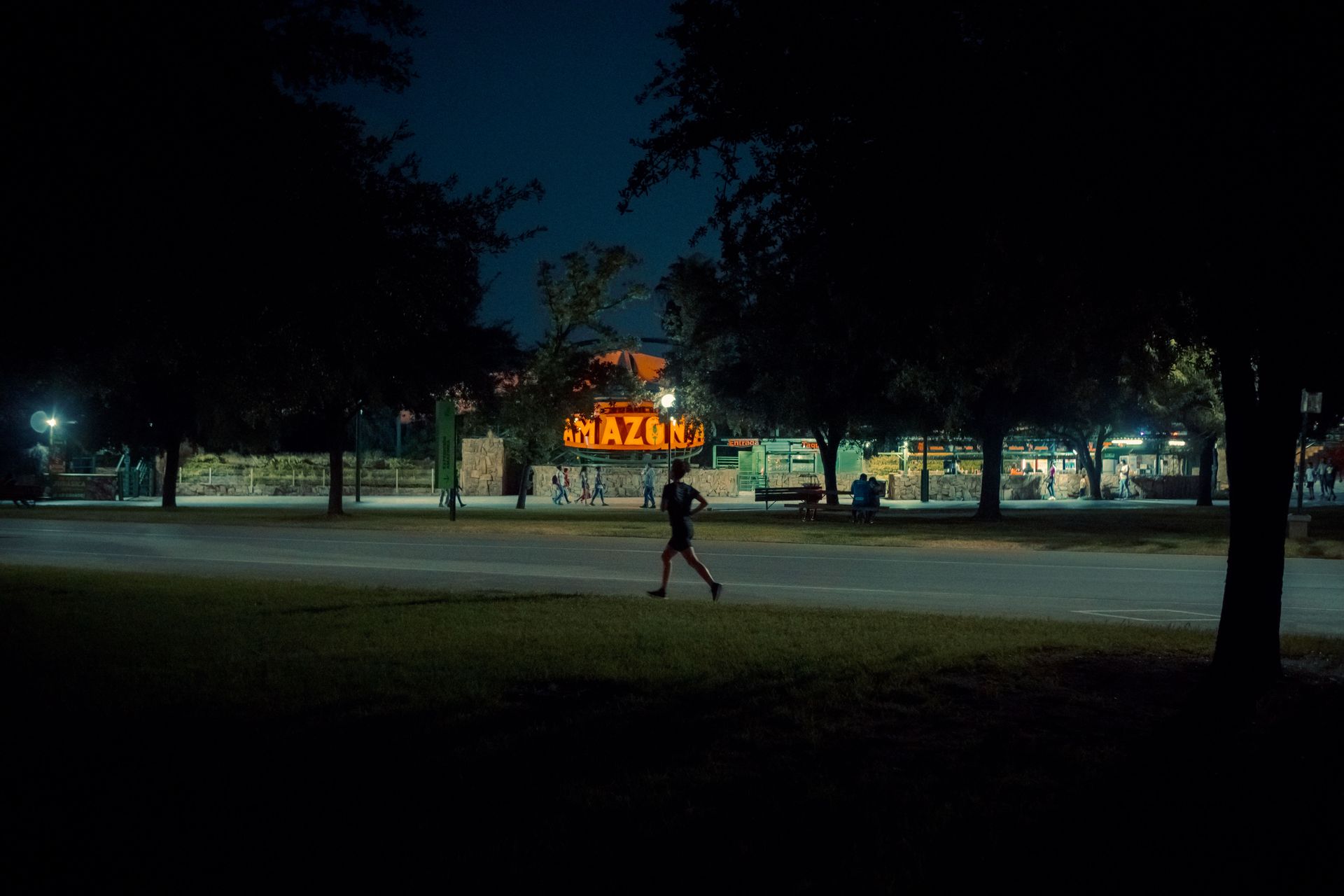
EQUIPMENT AND WHAT ACTUALLY MATTERS
- Lighting. You want a primary headtorch with a minimum of 350 lumens, and 500 is better on technical terrain. More important than the number is knowing your actual battery life under race conditions. Cold temperatures reduce battery performance significantly. Test this before your race. Also carry a backup headtorch. This is not optional as it is generally part of your mandatory kit. If your primary fails mid-race without a backup, you are in serious trouble.
- The shadow problem. A headtorch on your forehead creates flat light. The light source and your eyes are at the same level, so shadows fall directly back from objects. A rock in front of you casts almost no shadow. Your brain gets very little depth information. A waist or chest-mounted light changes the angle and restores depth perception on technical ground. If you are racing anything super technical at night, a second light source lower on your body is worth serious consideration.
- Warmth. Temperature drops overnight and keeps dropping until around 5am. Layer for it. A packable wind layer weighs almost nothing and changes everything if conditions turn. Carry it regardless of the forecast. Wear something reflective so your crew can find you at aid stations in the dark.
- Poles. If you use poles in training, night sections are when they earn their place. On descents they extend your contact with the ground beyond your visual field, giving you information about terrain before your feet get there. If you do not train with poles, do not introduce them for the first time at night in a race.
THE 4AM WALL
Most athletes who race through the night hit their lowest point somewhere between 3am and 5am. This is consistent enough and well-documented enough that it has a name. It happens regardless of how well trained you are, how good your preparation has been, or how strong the rest of your race has felt.
It is circadian, not fitness. Core temperature at its lowest. Melatonin at its highest. Cognitive function at its most compromised. Everything feels harder and slower and less worth it than it did at 8pm. That is not your body telling you something is wrong. That is your biology following its normal cycle.
The most important thing you can do when this hits is name it. Say it out loud if you have to. This is the 4am wall. I know what this is, I experience it every race! It is not permanent. Naming it is cognitive reframing that keeps you from making a permanent decision in response to a temporary state.
Then act on something small. Caffeine if you have timed it for this window rather than burning it at 10pm when you first felt tired. A short walk. A snack. Five minutes with your crew. Something that is not quitting. Most athletes who get through this window go on to finish. Most athletes who DNF here say afterwards they wish they had just kept moving for another hour.
TRAINING FOR IT
Most athletes train entirely in daylight. This leaves night running as an unknown on race day. And the unknown is what creates fear. The goal of night training is not to become a specialist. It is to remove the unknown so that when you hit that section in your race, it feels familiar rather than weird and scary.
Two to three night runs in the eight weeks before your race is enough. They do not need to be long. Sixty to ninety minutes with your race gear, on trail if possible, will calibrate your system in ways that no amount of reading about it will replicate. Your eyes adjust. Your pacing recalibrates. Your gear gets tested. That is what you are after.
If your schedule makes running at night difficult, sunrise runs starting 45 to 60 minutes before the sun comes up are the next best option. If nothing else, go for one run in the dark with your race gear on before your event. One run removes the unknown. That is the whole point.
WHAT TO TAKE FROM THIS
Night running is not a mystery and it is not something you have to be afraid of. But it is a different discipline within the same sport and it rewards specific preparation.
Your sensory environment narrows and you need to plan for it. Your pacing needs to shift to effort and breath rather than splits. Your gear matters more than it does in daylight. The 4am wall is real, it is temporary, and knowing it is coming is half the battle.
Your first night section in a race will probably be harder than you expect. That is normal. The goal is not to make it easy. The goal is to make it survivable and not frightening. You will not regret preparing for it. You will regret arriving underprepared
Isobel Tait is the founder of peak endurance coaching, based in melbourne. She has competed at the barkley marathons three times, represented australia three times at the world long distance mountain running championships, been australian trail champion twice, and won the six foot track marathon.
she coaches ultra runners in mindset, race preparation, nutrition, and performance.
iF YOU WOULD LIKE MORE INFORMATION ON BEING TRAINED BY Isobel, CLICK THROUGH HERE TO OUR AURA ENDORSED COACHES PAGE.



share this
IN OTHER NEWS
