



Coach’s Corner with Chris Dorman: Accessory conditioning for an ultra

Chris Dorman, MEx.Sci(StrgthCondg), BSci(SpSci), Grad.Dip.App.Sp.Ex.Nut.
STRENGTH, CONDITIONING, NUTRITION & PERFORMANCE COACH
Chris Dorman is a team sport strength and conditioning professional turned trail and ultra enthusiast and coach. Admiring the ability to endure, and with love of running through greenery and undulation, he now dedicates his pursuits towards immersing himself in the industry and preparing others for ultra adventures.
Accessory conditioning for an ultra: the principles and concepts used for compromised preparation
Running is going well, you enter a race, and then injury strikes. Sound familiar? This is the dilemma for runners. In pursuit of a challenge, we extend ourselves, then an issue, niggle or injury pops up. For mine, this process of running and competition is one of problem solving, and is now the way I approach coaching runners – with an agile approach to solving the issues associated with progressing training. A recent issue of my own highlighted the need for such problem solving in order to prevent withdrawal from and to complete a 50km ultra. This is the recount of my experience preparing for the Pemberton Trail Festival.
The dreaded Plantar Fasciitis struck. I knew it wasn’t going to resolve in a hurry, so rather than withdraw from the race, I took it on as a challenge and an experiment. Can I run 50km on the minimal amount of running that my foot could tolerate, and what accessory means, and methods, would get me there? I resorted to my education as a conditioning coach, asking what did I need to be able to complete this task? I was fully aware of the planning, training and physiology required for such an event, but much of that discussion revolved around being able to run. What if you can’t? What if you cannot physically perform and tolerate the recommended training time, volume, mileage, and time on feet that is necessary. What do you do?
Firstly, I was running and tried to run more, but as the event got closer, I resigned to the principle of the Minimal Effective Dose. This was determined not by what I perceived necessary to complete the event, but by what my foot was tolerating and how it felt day by day.
With the injury presenting itself at the end of May, June was a period of decreased frequency of training with attempts to manage the injury. July was the period where I fought through it, determined not to withdraw from the upcoming event. What did it result in? Obviously, the injury got worse, to the point that I had to undergo a change of mindset and approach. August represented the acceptance phase and minimal effective dose of running and a lot of accessory conditioning. In September, I was able to build my training a bit before the race in early October.
The principle of specificity would state that this de-loaded period of running prior to the event was clearly not enough. And if a runner had come to me with such a plight, as a coach I would have said, ‘Sorry, this is not the right event at this point in time.’ However, accumulating foundational, non-specific and general preparatory training in conjunction with the minimal effective dose of running, did the job for me, allowing me to complete the race.
The following accessory tools/strategies worked for me.
Cross Training
Although cross training/circuits/muscular endurance work may be considered non-specific to running, it is specific to ultra training and races. Why? From an output point of view, in repeated muscular contractions of smaller, more endurance-oriented muscle fibers, but from a muscle damage and fatigue resistance point of view. The increasing muscle damage associated with the progression through the ultramarathon event, via ascending/descending (eccentric muscle damage) and just time on feet, is a huge factor in fatigue and perception of effort with such events. Therefore, I decided to target this in my preparation, pre-conditioning for muscle damage. Could I increase my durability and resistance to damage and fatigue, enough?
Overload
Getting back to the needs of the event, what else did I need? I needed a non-linear component; movements that were not sagittal in nature and prepped me for the winding ascent/decent nature of trails. Also, with pack weight a consideration (1-2kg water, food, phone etc), the principle that I wanted to address and utilised here was ‘overload’. Overload a movement pattern that was similar to the mechanics of running, uphill running and stepping off the line when descending technical trail. So what did I come up with? The two movements and exercise threads that I used in a circuit design, were a Jumping Step-Up Exchange and an Over the Box Skater Variation. Further overload was created via the use of medicine balls, vests, vipers and fitness bars ranging from 5-16kg.
JUMPING STEP UP EXCHANGE
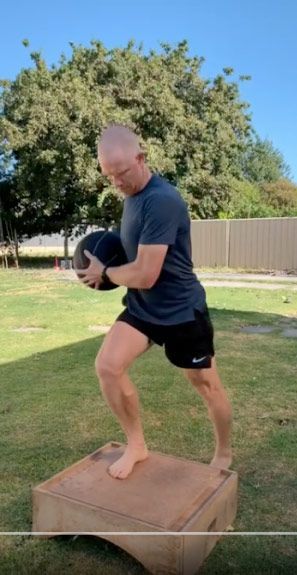
Small changes in movement can have big impacts from a conditioning point of view. Firstly, moving from a foot position that is in contact with the box, to the small lift, then driving into the box creates a more specific foot-strike to that of running inclines, increases force/power output in propulsion, but then increases the demand on musculature in absorbing the landing forces. Secondly adding rotation with the medicine ball for additional trunk muscle recruitment. Performed with increasing step rates, force output and load every minute for 5 minute blocks, it can really tax the legs.
SKATER PROGRESSIONS
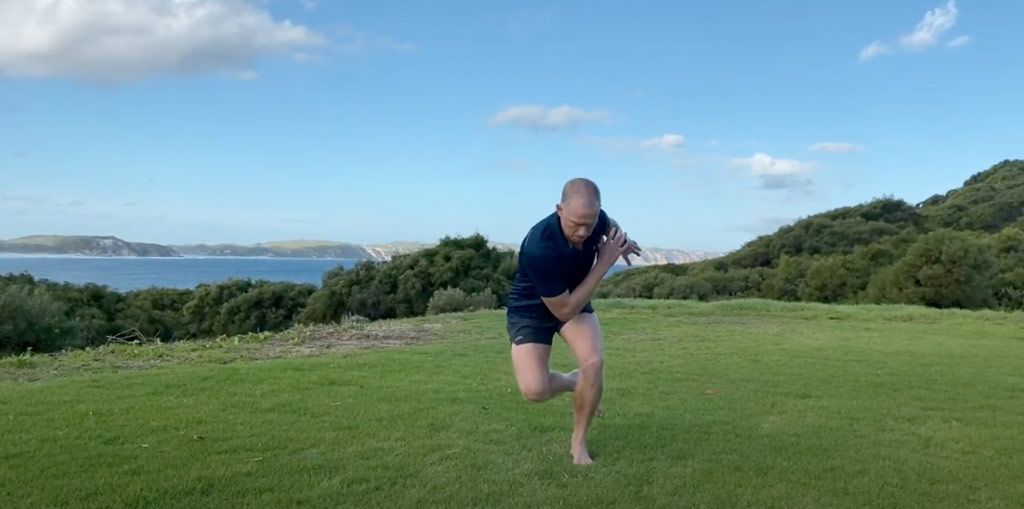
Predominantly the last variation in this video was performed, but others in the video can be used, and should be selected on movement competency. Again, simple movements such as ground touches and medicine ball false throws (press) can really increase the force and stability demands of this simple exercise.
Session Design:
| Duration | Activity | Load |
|---|---|---|
| 5″ | Bike, building heart rate but keeping in my aerobic zones (preferably 1&2) | Zone 1/2 |
| 5″ | 20cm box-Jumping Step-up Exchanges with increasing step rate/cadence every minute. | 5-16kg |
| 3-5″ | Bike | Zone 3 |
| 5″ | ‘Over the box’ Skater progression, with increasing Step rate/cadence every minute. | 5-16kg |
| 3-5″ | Bike | Zone 3 |
| 5″ | 20cm box Jumping Step-up Exchanges with increasing step rate/cadence every minute. | 5-16kg |
| 3-5″ | Bike | Zone 3 |
| 5″ | Over the box’ Skater progression, with increasing Step rate/cadence every minute. | 5-16kg |
| 3-5″ | Bike | Zone 3 |
| 5″ | 20cm box Jumping Step-up Exchanges with increasing step rate/cadence every minute. | 5-16kg |
| 3-5″ | Bike | Zone 3 |
| 5″ | 40cm (2 boxes) High Box Step-up Exchange with increasing step rate/cadence every minute. | 5-16kg |
Funnily enough, these exercises were tolerable with Plantar Fasciitis. Due to a lack of toe off and forward/horizontal propulsion in both these exercises, the Windlass mechanism of the foot, doesn’t tension the Plantar Fascia. Therefore, they remained tolerable with additional loads and increased Step rates (a problem-solving victory!) over a good conditioning block. This session was performed once to twice per week and using the progressive overload principle (gradually increasing loads) over several weeks and often in conjunction and stacked with others, running (when I could), inclined treadmill (sometimes loaded) walking, and bike sessions.
I sincerely hope this can help others in a similar position.

Founder, RAS Runners-Endurance Coaching Service (online).


share this
IN OTHER NEWS
