


FOCUSED ON THE PROCESS: GORE
Contributed by Phil Gore, AURA member (Darling Downs, WA)
LIGHTHORSE ULTRA, WOODVALE (WA), 30 April 2023
The Light Horse Ultra is one of those looped courses that I love, but not the 6.71km with no finish line variety. This one is a 2.5km loop and you just do as many as you can within the time limit. You know exactly what time the race finishes and every minute that ticks by is a minute closer you get to the finish line, even if you aren’t moving. You can stop when you want and for as long as you want. Or, you don’t even have to stop at all. The more time you spend moving, the greater your overall result. There’s something for everyone with 1, 3, 6, 12 and 24 hour options. There’s a special race for kids, and this year they even introduced a race for dogs.
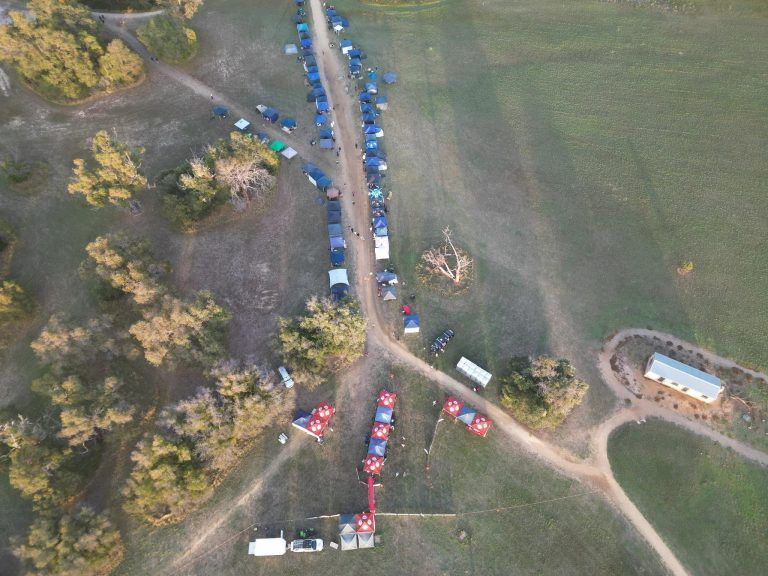
The event is held on the weekend closest to ANZAC Day every year and honours those who had served or are currently serving in the armed forces. I first ran this event in 2019 and I enjoyed it so much that I have returned every year since. I have done the 12-hour twice and the 24-hour twice.
As much as I love to test myself over the 24-hour format, with only a short recovery/training window since Herdy’s Frontyard, and with the Backyard Masters not too far away, I thought the 12-hour format would be a better option. I’d still able to knock out a decent distance, but without pushing myself too much and requiring too much recovery time.
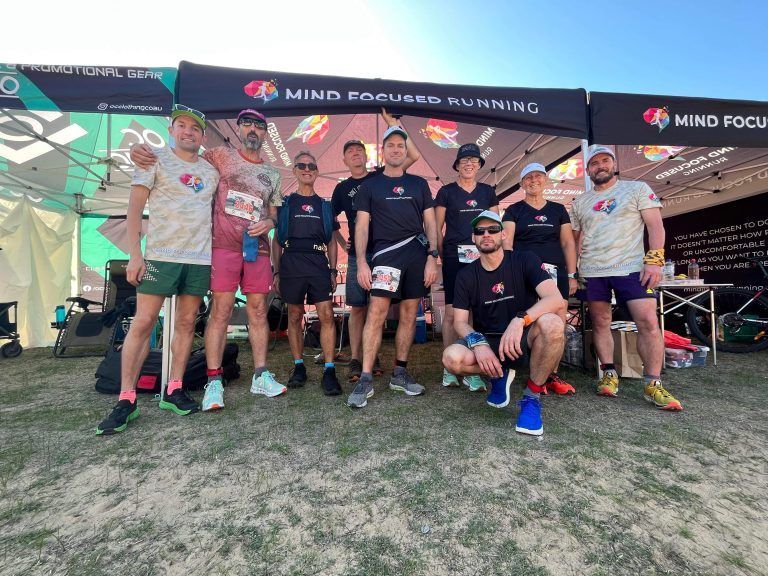
I arrived at the event on Saturday morning and with the help of Rob Donkersloot, we set up a few marquees that would act as a hub for our group of Mind Focused Runners. The 24-hour runners started at 3pm that afternoon, but the 12-hour wouldn’t start until 12 hours later. I cheered on the 24-hour runners for a few hours before sneaking off for a sleep in my car. Going to bed around 6pm meant I could get a full sleep beforehand, and start the event feeling fresh.
We started at 3am on the Sunday morning, which I personally think is the perfect timing for a 12-hour race. Although not a time of day commonly associated with being awake, it’s not unheard of for serious runners to have the occasional early wake-up for a run at this time. Particularly during the hot summer months, I know I like to start some of my long runs quite early and aim to have them done and dusted before sunrise. With the event starting at 3am, it means I can tackle the toughest hours of the day first, get to experience sunrise (my favourite time of day, particularly when running), and finish before the heat gets a chance to peak in the late afternoon.
I went into the event with a goal of 137.5km. That might seem like an odd number, but remember, each lap is 2.5km, and you don’t really want to plan to finish partway round on a lap. 137.5km is exactly 55 laps, and just slightly higher than my result from last year (and 12-hour PB) of 136.39km. Keeping in mind that this wasn’t my A-race, I felt 137.5km was a reasonable distance to aim for. I also had a back-up plan for 127.5km, to allow myself to take it a bit easier if I needed to. As with any ultra-marathon, it’s a lot more manageable to break it down into smaller sections. In a traditional distance-based ultra, this will usually be the distance between aid stations, or other landmarks. When writing my plan for this event, I broke it down into four 3-hour blocks, coinciding with when we change directions. Starting out with a relatively quick pace of 4:48/km, every three hours I dropped the pace a little to account for a fade, with my last three hours sitting on 5:23/km. And between every 3-hour block, I allowed myself 5-10 minutes for a break.
The weather was quite chilly as we set off, but one advantage of having an aid station every 2.5km is that you can just wear extra layers at the start and shed them as required. You are never going to spend too long at a time being overdressed. In my training runs I always try to wear as few layers as possible, often not wearing anything more than a t-shirt and shorts, even on the coldest of mornings. It’s good for cold adaptation as well as mental conditioning, getting comfortable with being uncomfortable. However, when it comes to running in an actual event, I find it is more important to maintain some level of comfort and keep warm, which in turn helps to reduce energy expenditure and promote a better overall performance.
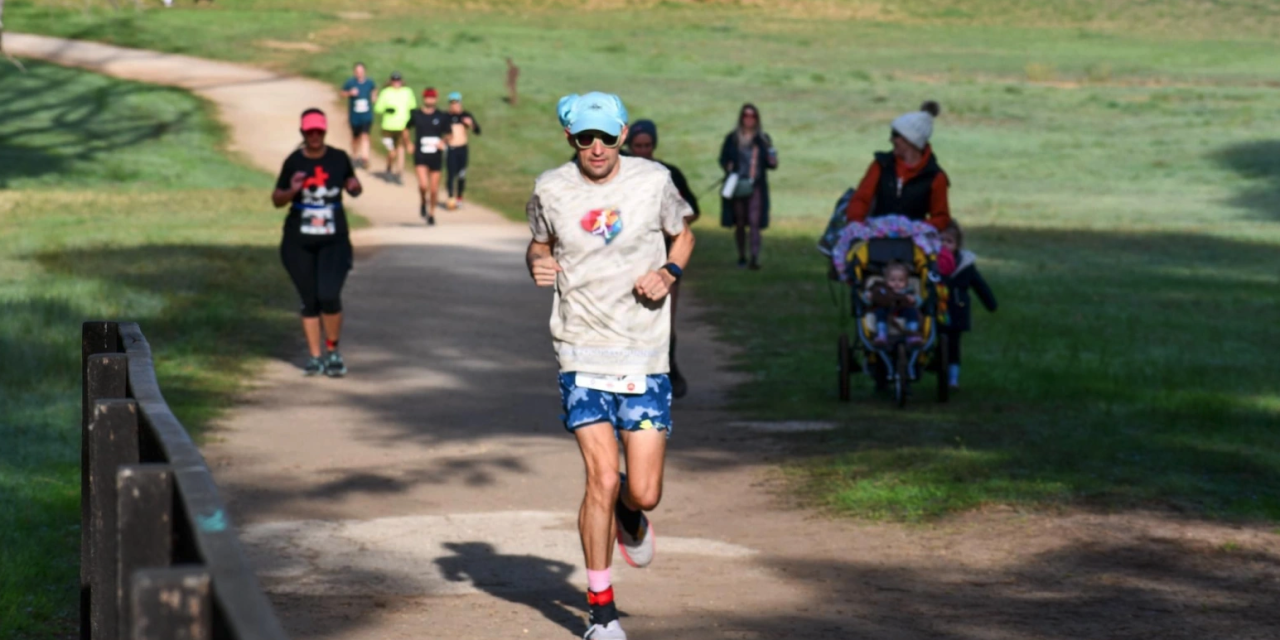
The first 3 hours went by like clockwork. I was literally within a minute of my target time for every single lap. I felt really confident with my pace, it didn’t feel like I had started out too fast or too slow. My wife Gemma was my crew as usual, and she was on the ball with making sure I had what I needed at the planned intervals. It’s not like a backyard where I stop for 15 minutes every hour and there’s a bit of time to get my stuff sorted. For this event I just run past the marquee and Gemma has to have what I need ready in hand, so I can just grab it and keep moving. Besides my longer breaks, most of my food is specifically chosen because it can be eaten on the run, or at the very least, can be eaten quickly as I slow down to a walk.
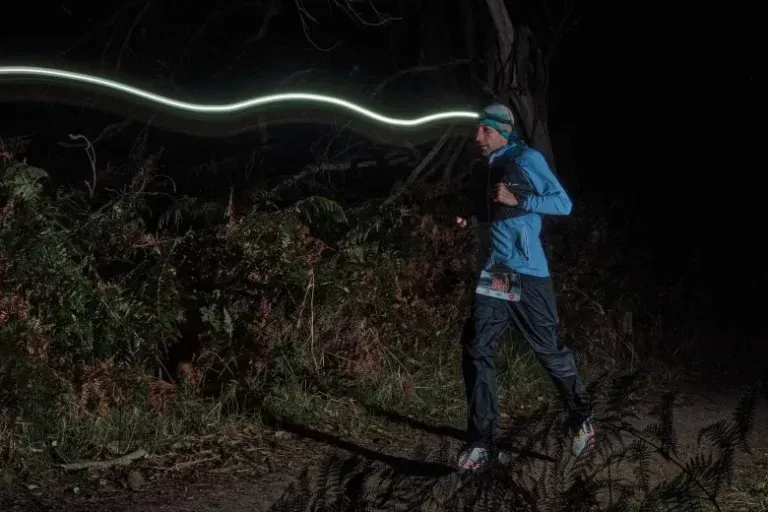
By 6am, I had completed 37.5km, which was dead on target. And I reached the first milestone – I got to change directions! We had started in an anti-clockwise direction and now we got to run clockwise. It’s always pretty exciting when that happens, it’s almost like you are on a new course. We also got the first hint on sunlight and the 6- and 3- hour runners started their race. As I approached the marquee after turning around, I slowed down for my first break, I had allocated five minutes. And then the next three hours were just like clockwork again – always within a minute of my target time each lap. It was around this time that it started warming up, and within a few laps of sunrise, I had removed all my outer layers. This period is also generally the most social time of the event, with all the races from 3 to 24 hours happening simultaneously on the one course. There’s always plenty of people to say hi to as you make your way around each lap. It doesn’t matter what pace they are running or what stage of the race they are at, everyone gets to see each other at some stage.
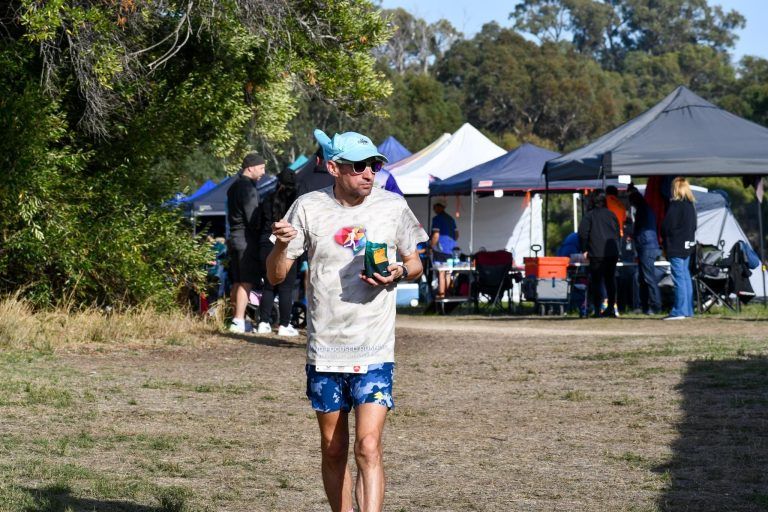
By 9am, I was still right in line with my target with 72.5km completed. We turned around again, and I had my next break. I had allocated 10 minutes for this one just in case I needed time for foot baths or outfit changes. I needed neither, but I still took the opportunity to sit down and rest my legs for a few minutes while I ate my beef teriyaki. I only took 6 and a half minutes for my break so by the time I started my next 3-hour block, I was three and a half minutes ahead of schedule. And it pretty much stayed that way until my next break.
By 6am, I had completed 37.5km, which was dead on target. And I reached the first milestone – I got to change directions! We had started in an anti-clockwise direction and now we got to run clockwise. It’s always pretty exciting when that happens, it’s almost like you are on a new course. We also got the first hint on sunlight and the 6- and 3- hour runners started their race. As I approached the marquee after turning around, I slowed down for my first break, I had allocated five minutes. And then the next three hours were just like clockwork again – always within a minute of my target time each lap. It was around this time that it started warming up, and within a few laps of sunrise, I had removed all my outer layers. This period is also generally the most social time of the event, with all the races from 3 to 24 hours happening simultaneously on the one course. There’s always plenty of people to say hi to as you make your way around each lap. It doesn’t matter what pace they are running or what stage of the race they are at, everyone gets to see each other at some stage.
By 9am, I was still right in line with my target with 72.5km completed. We turned around again, and I had my next break. I had allocated 10 minutes for this one just in case I needed time for foot baths or outfit changes. I needed neither, but I still took the opportunity to sit down and rest my legs for a few minutes while I ate my beef teriyaki. I only took 6 and a half minutes for my break so by the time I started my next 3-hour block, I was three and a half minutes ahead of schedule. And it pretty much stayed that way until my next break.
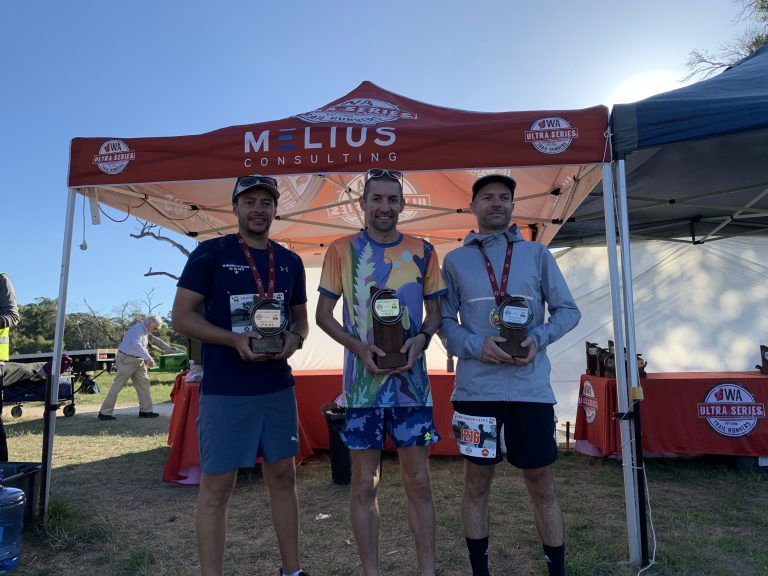
I’m extremely pleased with my race experience, not just specifically about my overall result but more so how I felt in the journey of getting there. I’m very process-driven with my running and it’s incredibly satisfying when everything seamlessly falls into place. From the very beginning to the moment the race ended, I felt an unwavering sense of equanimity. I maintained a steady running pace throughout the entire race, never feeling the need to walk or to pause (with the exception of a few moments when I had to eat or go to the toilet). I never encountered any significant physical or mental challenges along the way. It truly was an incredible experience and a massive confidence booster for my future running endeavours.


share this
IN OTHER NEWS
